Tuesday, April 22, 2014

Earth Day and Environmental Justice

Happy Earth Day! I wrote a thing for the Global Ministries website for their April focus on the environment. You can read it here or below. It touches on the tragic epidemic of Chronic Kidney Disease (CKDu) affecting sugar cane workers in Central America, plus a little bit about environmental justice and how awesome our students are. Below the article are links for further reading, including photos and videos that are worth a click.

As it turns out, the CKDu epidemic also made the cover of Science magazine this week (article link here, sadly paywalled), thanks to some new studies that were recently announced. Here's hoping more scientific attention will pave the way for workable and just solutions.


Everything Will Live Where the River Goes

Written by Timothy Donaghy
April 15, 2014

The Book of Ezekiel offers up a beautiful vision of humans living in harmony with the natural world:
“He said to me “Mortal, have you seen this?” [...]
9Wherever the river goes, every living creature that swarms will live, and there will be very many fish, once these waters reach there. It will become fresh; and everything will live where the river goes. 10People will stand fishing beside the sea from En-gedi to En-eglaim; it will be a place for the spreading of nets; its fish will be of a great many kinds, like the fish of the Great Sea. [...] 12On the banks, on both sides of the river, there will grow all kinds of trees for food. Their leaves will not wither nor their fruit fail, but they will bear fresh fruit every month, because the water for them flows from the sanctuary. Their fruit will be for food, and their leaves for healing.” (Ez 47:7-12, NRSV)
In this passage we find ourselves immersed in Ezekiel’s promised land, with trees on all sides and our toes in the river. Our baptism into nature brings us both abundant food and good health. There are fruit and fish and even the leaves of the trees have the power to heal. We know instinctively that there is an intimate connection between our health and the health of the natural world. After all, without healthy food, clean water and clean air the human body cannot survive. Even when our modern world locks us away in office buildings and parking lots, our connection with the creation can only be muted but not severed.
Over the past year, Laura Jean and I developed and taught a university class making the connections between environmental science and theology. Her background is as a pastor and theologian, mine as a scientist and environmentalist. We also strove to base the class on the concepts of popular education, which takes as a starting point the experiences, expertise and values of the students. The first assignment was to reflect and write about an environmental problem that affects their local community. Our students came from a variety of backgrounds – women and men, rural and urban, young and old – and they told us vivid stories of neighborhood trash heaps, erosion and floods, contaminated lakes, the loss of fresh water springs due to deforestation, and more.
One group of five students traveled every week for our class, two hours or more each way, from the cities of León and Chinandega in the western region of Nicaragua. One had to leave his house at four in the morning to catch the first of three buses that would bring him to class in Managua. These students had grown increasingly concerned with the news from their region about a mysterious and tragic epidemic of kidney disease that was killing young sugar cane workers. For their final project for the class, the group got to work doing interviews and pastoral counseling with the sick workers, their families and community advocates. It was a moment that every teacher lives for, when the ideas up on the blackboard resonate with the lives of your students and then catch fire.
In developed countries, Chronic Kidney Disease (CKD) is an ailment that affects mainly older people suffering from diabetes or high blood-pressure. Often it can be controlled with diet and medication. In Nicaragua CKD is an aggressive illness that affects young, otherwise healthy men. It is painful and progresses rapidly, leading to kidney failure and death in a matter of years. In some regions nearly 50% of all male deaths are from kidney failure. One village has watched so many of its young men die that it is now known as the ‘Island of the Widows.’ The epidemic has been growing throughout Central America, from the south of Mexico down to Panama.
The disease poses a scientific mystery. The epidemiological evidence points to extreme dehydration and hot working conditions as key factors damaging the kidneys. Such hot working conditions are indeed typical in the sugar cane fields of Central America. However, workers have been cutting sugar cane in these fields for centuries, but it is only in the past few decades that kidney disease has appeared. Other sugar cane producing regions such as those in Cuba and Brazil have not seen similar epidemics, although similar cases have been reported as far away as Sri Lanka and India. This has led some researchers (including the Ministry of Health in El Salvador) to speculate that another factor – possibly contamination of drinking water by heavy metals or pesticides – is playing a role in triggering or worsening the disease.
In Nicaragua, the sugar cane plantations are owned by the country’s richest family, the Pellas, and the cane is processed to make sugar and Flor de Caña rum. The sugar plant admits no responsibility, although they have taken some steps to insure that workers have access to hydrating fluids and they have put some money toward scientific studies of the disease. Nonetheless, there are a large number of current and former workers suffering from the disease many of whom lack access to dialysis and medical care. This has led to ongoing contentious protests against the sugar plant. Earlier this year, police fired on protesters camped outside the plant gates, killing one protesting worker, Juan de Dios Cortés, and injuring several others.
One of the concepts we highlighted in our class was the idea of environmental justice. In the United States, the environmental justice movement grew out of the civil rights movement, drawing attention to the fact that people of color have borne an unfairly heavy burden of environmental contamination. Toxic waste sites are located disproportionately in communities of color, whose residents then must pay the economic and health costs of their contaminated environment. The United Church of Christ (UCC) has a long history with the environmental justice movement. In 1987, the UCC Commission for Racial Justice published an influential report titled Toxic Wastes and Race in the United States that brought the struggle to a wider audience and started a conversation that has led to some reforms.
The banner of environmental justice has spread far beyond the U.S. and has been taken up across the globe by indigenous groups fighting off transnational corporations, by landless campesinos and urban squatters, by people everywhere demanding an equitable solution to climate change. Our students made the case that the epidemic of CKD among sugar cane workers was also an example of environmental injustice. Whether the primary cause of kidney disease turns out to be harsh working conditions or environmental toxins or some combination of causes, it is clear that the overall environment of these workers is literally killing them. And when our brothers and sisters are too poor turn down a job they know might kill them, and who are too poor to afford health care once they get sick, we are witnessing an extreme lack of justice.
The beautiful vision found at the end of Ezekiel is in direct contrast to the earlier chapters of the book. Before we were exiles, alienated from nature, lost in the valley of the dry bones. We suffered, we became sick, we lacked for healthy food and clean water. Even the air we breathed was dusty and unhealthful. But now we have been restored, renewed, revitalized, reenergized. With the blessings of God, the land blossoms and so do we.
Further Reading
  • The website Global Voices has highlighted the work of photo-journalists Ed Kashi and Esteban Félix who have documented those suffering from CKD in Nicaragua. A video based on Félix’s photography is below. [VIDEO]
  • Over the past 3 years Sasha Chavkin of the Center for Public Integrity has published a series of articles on the disease. The epidemic has also been covered by the Guardian, Scientific American and the Associated Press.
  • The website Confidencial reported (spanish) on the recent tensions between workers, the sugar plant and the government. Following the recent violence a group of Nicaraguan and international organizations signed a declaration calling on the government to address the situation.
  • In 2007, the UCC Justice & Witness Ministries published an updated report Toxic Wastes and Race at Twenty, which is a good introduction to both the history and current situation of environmental justice in the U.S.

Thursday, March 27, 2014

Day -5: Despedidas

We are now in that final stretch where every time we see someone we part with hugs and promises to return to Nicaragua some day. In between packing and liquidating our belongings, we've been visiting the local churches for one last culto, a round of hugs and prayers for our journey. It's very much the reverse of our first week in Nicaragua when we were driven around from church to church for a round of introductions.

We've had our share of goodbye parties, or despedidas, too over the past few weeks with friends and co-workers. The picture above was taken with Revda. Pilar at a goodbye service at the 2nd Church in Managua. Doña Pilar was the church president when we first arrived and it was her who welcomed us at the airport and made sure we were comfortable and well-taken care of during those first few weeks while we were finding our feet. The hard part is saying goodbye, but it's great to know we've got friends here thinking about us head back north.

Thursday, March 13, 2014

Day -19: Español

Without a doubt one of the things I will miss the most about Nicaragua is the opportunity to speak Spanish every day. I've found learning a new language as an adult to be a perpetual motion process. You have to keep learning and practicing and moving forward or you start to slide backwards. I'm pretty proud about how far I've come learning Spanish. No one would ever mistake me for anything other than a gringo, but I do OK.

But even after short trips to the states I start to feel rusty, so I'm worried that I'll go back to the U.S. and it will all melt away. Now of course we're moving to California and there are tons of Spanish-speakers who live there, so I'm sure I'll have plenty of opportunity to practice. But the great advantage of being immersed is that you have to use your Spanish every day all the time. I'm not sure that'll be the same in California, but we'll see.

With the girls it is a different story. Maya is two and a half years old now, and she's just now starting to talk more confidently in both English and Spanish. Like almost all kids raised in a bilingual environment, her language development has been slower. (Bilingual kids universally start slower but catch up to their age-mates over time.) Some of her first words were an adorable mix of both languages like gat (halfway between gato and cat) or lun (luna and moon). Even now there are certain things that she'll only say in one language or the other, and she's definitely starting to separate the two more consistently. It has been fascinating to see how different her process has been from her sister. Since she's Nicaraguan by birth we feel a responsibility to help her maintain both languages, but she's so young that it might be pretty difficult.

After four years of Nicaraguan school, Quinn is perfectly bilingual, and she's old enough that it seems more likely she'll be able to keep up her Spanish even in the states. We are hoping to enroll her in a bilingual public school in California when we get there. I never cease to be amazed by her ability to switch effortlessly between the two languages. She still has some "spanish-isms" that creep into her English, by which I mean she says something in English that has the structure or vocab of a common Spanish phrase. One time when the power went out she informed us that "The lights went" (spanish: Se fue la luz). Or she will refer to "touching the guitar" instead of playing it, since Spanish uses that verb instead.

At times when I overhear her talking with her friends her Spanish accelerates to such a velocity that I can barely understand her. I used to worry that I should be able to always understand what my kid is saying, but now I think it might be a metaphor for parenting. Maybe at some level kids always speak a slightly different tongue than their parents.

Wednesday, March 5, 2014

Brief Musings on Bread (and Fasting)

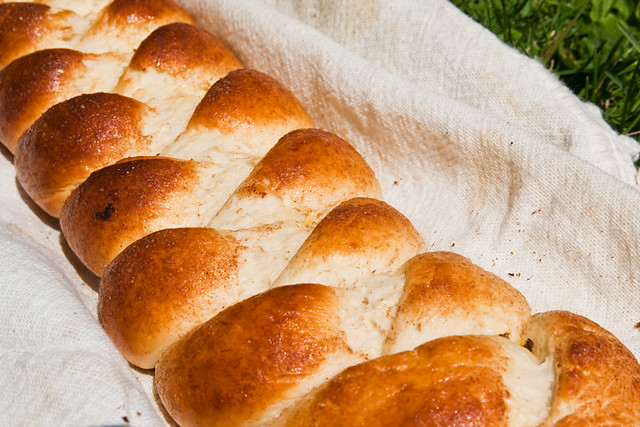
photo by Steven Depolo, Creative Commons Attribution license

Three sayings about bread wove themselves together in my mind recently, and they seem appropriate for a time when many are beginning a season of fasting.

I recently came across this quote for the first time by Nikolai Berdyaev, who was a Russian religious and political philosopher:

"Bread for myself is a material question.  Bread for my neighbor is a spiritual one."

As many people enter into Lenten fasts, I wonder about the connection between denying "bread" (or chocolate, or donuts, or...) to ourselves, and being mindful of our neighbors, near and far, who are without bread.  Is there a connection?  Should there be?  World Vision Youth is organizing a solidarity fast, and although the word "Lent" doesn't seem to appear anywhere, the timing is just right.

I don't remember when I first heard the most famous words of the Brazilian archbishop and liberation theologian Dom Helder Camara, but they have stayed with me:

"When I give food to the poor, they call me a saint. When I ask why the poor have no food, they call me a communist."

We might think that political and spiritual questions can (and should) be kept separate, but as simple a topic as food (and hunger) reveals that, if we believe that "bread for my neighbor" is a spiritual question, one that we are willing to seek answers to, any effort providing that bread soon leads us to more questions, which are often unpopular, even dangerous, politically.

The sung blessing for a meal that ties together these two quotes for me is one I learned here in Nicaragua, that has been shared through the Latin American Council of Churches' (CLAI) Liturgy Network:


Bendice Señor nuestro pan

y da pan a los que tienen hambre

y hambre de justicia

a los que tienen pan.

Bendice Señor nuestro pan.

English translation:
Lord, bless our bread.
and give bread to those who are hungry
and give hunger for justice
to those who have bread.
Lord, bless our bread.

May our bellies, whether filled, fasting, or hungry, hunger for justice.

Thursday, February 27, 2014

Day -33: The Full Circle of Partnership

The book of Ephesians 4:1-17 describes the church's call to unity this way:
"Speaking the truth in love, we must grow up in every way into him who is the head, into Christ, from whom the whole body, joined and knitted together by every ligament with which it is equipped, as each part is working properly, promotes the body’s growth in building itself up in love."
This passage was part of a bible study that we led recently with some of our colleagues here at the Inter-Church Center for Theological and Social Studies (CIEETS). The passage led us into a rich dialogue of reflection on what the "ligaments" are that join and knit together the various programs of CIEETS, and has led us to reflect on what those "ligaments" might be that bind U.S. churches to those here in Nicaragua.

Thanks to the work of CIEETS, dozens of rural Nicaragua's most impoverished communities now have access to clean water, improved sanitation, a more reliable food supply, better nutrition, and organic farming methods that help conserve the soil and protect the environment. Thanks to CIEETS, thousands of women and men are reading the Bible together, learning about the importance of social issues for the church, and awakening to the power of women doing theology (who have for so long had theology "done to" them). Thanks to CIEETS, many Nicaraguan Protestant churches have trained pastors and leaders committed to improving life for their communities and their country.

CIEETS organizes its work in two areas: the theological faculty (FEET) and the area for sustainable development and the environment (AMAD). At first glance, these might seem like wildly different areas of focus, but on closer inspection the overlap offers much fertile ground.  In last week's meeting, agronomists and theologians alike described their shared vision of and commitment to social justice that is integrated with Christian faith.

We were invited to facilitate this dialogue to help discover ways the two branches can work together to strengthen the entire institution.  We were asked to facilitate primarily because my work is in theological education and Tim's is in sustainable development and environmental education.  Last year we co-taught a class on Ecology and Theology (in the FEET), and in that course we took the undergraduate theology students to visit one of the AMAD projects, a concrete example of development projects that care for the environment and for people.

Before we closed, they had created a list of 8 concrete things they can do to help each other and learn from each other, starting next month and into the future.  This kind of work is more gritty than glamorous, but it is important for the optimal functioning of the whole.

The Ephesians passage, and the focus on organizational unity took me back to the first Bible study I was ever asked to lead in Nicaragua, in the fall of 2010, in El Sauce, in the Western region.  In preparation for the Christian Mission Church elections in March 2011, our friend Carlos was giving trainings in the rural regions to pastors and delegates on the church by-laws, focusing on the requirements laid out for elected leaders.  I prepared a brief reflection and questions for discussion on the same passage from Ephesians, focusing on the by-laws as the "ligaments" that hold the congregations and the national church together.

What I remember most about that visit was the feeling of fumbling.  I was still learning Spanish, and put hours into writing 4 or 5 questions that I hoped would be intelligible.  Speaking was hard, and trying to understand rural dialects for the first time even harder.  I fumbled as I took Quinn (age 3) to the latrine at night with a flashlight.  Neither the child nor the flashlight fell in, but it was not pretty. And Carlos laughed (not unkindly) as he read one of the questions I had written, which betrayed my total ignorance of a lively internal debate about the nature of spiritual gifts.

Despite that fumbling, we were welcomed with love from the beginning, and have learned so much from La Misión Cristiana and CIEETS.  As we come to the end of our time in Nicaragua, and prepare to travel to U.S. churches sharing stories of our time here, I realize that the work of Global Ministries is also a powerful "ligament" in the body of the global church. Our presence here is a powerful reminder to our Nicaraguan partners that the UCC and Disciples value and support their work. Our presence in North American congregations will share the good news of what other parts of "the body" are doing in other parts of the world.  In my mind, it "completes the circle," of being in relationship across borders.

PS - Over a decade ago, a teaching pastor and mentor of mine gave me a volume of The Gospel in Solentiname, and those dialogues by campesinos on a remote archipelago about the gospel readings were my first introduction to Nicaragua. They were compiled by Ernesto Cardenal, a priest and leader in the liberation theology movement and the Nicaraguan revolution.  We made the pilgrimage to Solentiname last weekend, and it is lovely to see how it has been developed as a tourist destination enough to generate income for the community, while still preserving the lush natural environment.  Another circle completed!

Monday, February 24, 2014

Day -36: More faces

Laura Jean and Pastora Celia Manzanares, during our recent trip to the Northern Regional Assembly. Celia is currently pastor of the Eighth Church in La Colonia, although she and her husband may soon be moved to another church in the 3-year rotation that comes after every national assembly. La Colonia was the church that hosted the theological classes for that region so we got to know Celia and her family really well during our visits. In particular Quinn and her grandson, Cristian, are thick as thieves. Her she is showing off her diploma for completing the 2-year course on ministerial formation.

Friday, February 21, 2014

Day -39: Quincho

Tonight we're crossing another thing off our fun list! We're going to see Carlos Mejía Godoy perform! You can think of Godoy as the Bob Dylan of Nicaragua, author of a distinctive style of music, the bard of the 1979 revolution and still a hard-working performer at age 70. He usually plays a few times a week but we've never gotten around to seeing him live. The song below is "Quincho Barrilete" an ode to the indomitable youth of Nicaragua, and a song that I will for the rest of my life associate with our boss, Felix Ortiz. He knows why.

Thursday, February 20, 2014

Day -40: La Musica

Last month we went to Rosa Grande for one of La Misión Cristiana's regional assemblies. Most nights after dinner a bunch of the more musically-inclined pastors would sit around and play. It was a real treat to listen to. I've been blogging a bit about the music that is used in the worship services, but those songs are mostly from Managua churches. In the campo it's an entirely different musical culture and a different set of shared songs. Here they are planning an accordion plus several variants of guitar (the big bass guitar is called a guitarón). The video is a bit dark, but the sound comes through nicely.

Wednesday, February 19, 2014

Day -41: Bucket Lists

Laura Jean tells me that I am not allowed to use the term "bucket list" to describe the long list of things we want to do before we leave the country because that list is for things to do before you kick the bucket. And she's right that finishing up our time in Nicaragua is not remotely like dying. For one thing, we know the exact date: 41 days from today. However, a good friend did once tell me that "leaving Nicaragua is a little like grieving" and that seems about right.

It feels like we are marching through a long list of last things. Every time we visit a church or a community we are conscious that we probably won't be back soon (I won't say never) and that we are saying goodbye to friends and places. In January we attended regional assemblies in San Juan de Limay and Rosa Grande, and those may well be our last big multi-day trips to el campo, which has been such a part of our work rhythm here. More frantically, those remaining 41 days are already filled up with meetings and finalizing projects and a long list of "must dos" that seems to accelerate as we get closer to the date.

This weekend we took a few days to cross something off our "fun list" and visited the Islands of Solentiname, an archipelago of some 30 islands located in the far south of Lake Nicaragua where it drains out into the Río San Juan. The islands have an incredible cultural history: in the 1960s father Ernesto Cardenal helped organize a community there around the principles of liberation theology, and also fostered a remarkable renaissance of painters and artesans who still live and work there. The remoteness of the islands has also preserved its remarkable biodiversity. The only power on the islands comes from solar panels and there are birds everywhere. It was a great trip, although too short, as everything seems to be these days. (Pics hopefully coming soon.)

Thing I Will Miss About Nicaragua: the natural beauty of the country is remarkable and you don't have to go far outside of Managua to find it. Of course there are beautiful things everywhere you go, but I will miss the tropical forests, the surging greenery everywhere you look, the birds, even the bugs (I guess).

Friday, January 31, 2014

Speaking to the Listening Heaven

The First Church of La Misión Cristiana is located in Acahualinca, a densely populated and very urban neighborhood of Managua. But the majority of La Misión Cristiana's churches are in the countryside -- small churches serving small and widely flung communities, sometimes a day's journey or more from the capital. Just like in the U.S., there can be a real cultural divide between rural and urban congregations, especially when travel and phone communication are not so easy.

Bridging that divide has been one of the goals of the First Church. For two years now, they have organized youth group trips to plant trees at a farm beyond Waslala owned by the church, and to visit the rural churches in the northern region. This past October, Magyolene and I got to tag along on the trip. There were 11 of us in total: Pastor Enrique, Sonia, Johanna, Mayito, me along with the jovenes (youngsters) Joelia, Melissa, Cinthya, Darichela, Karina and Carlos.

Cinthya and Mayito on the bus.
Just getting to the farm is itself an adventure. We left Managua before dawn on the express bus to Waslala. After arriving around noon, we ate a quick lunch and caught an incredibly packed local bus that dropped us off at the farm in a heap of suitcases, hammocks, rubber boots and provisions. The next morning we awoke with the rooster and tramped up the hill to plant trees.

The farm is known as Las Jaguas. For several years now, la Misión has been working to create a viable dairy operation on the property. With the help of Disciples church from Idaho they have build milking structures, planted fodder and build fence posts. This coming year they plan to purchase their first heads of cattle. The farm itself is fairly large and is quite hilly, with sections cleared for pasture and crops, but big swathes left wild. The paths to the upper fields head straight up the side of the hill, which Juan, the local caretaker, and his family seem to run up without any visible effort. But for the rest of us city slickers, getting to the top without slipping and falling in the mud was an accomplishment to be proud of.
Starting small.
I had a line of poetry from Tagore stuck in my head during our trip: "Trees are the earth's endless effort to speak to the listening heaven." Given how important forests are in moderating the local climate and water cycle, you could almost read that line of poetry as an instructive ecology text. In many parts of Nicaragua, farming and cattle ranching has driven some extreme deforestation, even deep in the heart of the Bosawas reserve. The good news is that the government does seem to try to enforce the law where they can: last year the church had to get a permit just to cut a few of their own trees to make fence posts. But beyond just caring for the environment, re-planting trees is important for the long-term viability of the farm. It rains a lot here (and I mean A LOT) and floods and erosion are very real threats to Nica agriculture.
Carlos and Joelia, resting for a moment in the shade.
The view.
Uff.
Cinthya, Karina and Melissa.
Hydration is important.
We spent two mornings planting acacia trees. This involved lugging the saplings up from the nursery to the place where they would be planted. Carlos and I were in charge of digging the holes in the sticky, muddy earth, which we did with shovels and a narrow-bladed tool with a replaceable wooden handle. The rest of the group would then plant the saplings along the fence-lines. We got some awesome blisters.

Our goal was to build "living fences" that lined the edges of the fields that were planted with corn. The trees planted by the group last year had survived and were already a decent size. All of us worked pretty hard. We think we planted more than 300 trees during two days, and each night we slept hard in our hammocks.
The group, hiking to visit the ojo de agua.

After lunch on the second day we decided to hike to the ojo de agua (fresh water spring, literally, the "eye of water") that gives potable drinking water for the farm, and the cattle. A few years ago the church paid to run a PVC pipe from the spring down to the farm house, a distance of nearly 2 kilometers. It was a beautiful walk, running through the forest and along the stream bed, following the white thread of pipe through the greenery. We visited the part of the farm where they had planted cacao trees that would soon be giving their first harvest. Of course, halfway to our goal, the daily afternoon downpour caught us, soaking us completely to the bone.

Kenia and Mayra, showing us a cacao tree.
Sonia, seconds before getting drenched by the rain.
Being caught in the rain is a much more pleasant experience in Nicaragua than in the U.S., where you are always a least a little worried about getting cold. Not a problem here. In fact, if it weren't for the fact that I wear glasses, I would just relax and enjoy the soaking. At any rate, we pushed on. Juan cut giant leaves to serve as makeshift umbrellas for us. We returned completely bedraggled.
¡Lo hicimos!
Hiking to Las Nubes.

On Sunday, our plan was to visit a local church named Las Nubes (The Clouds). This involved catching another before-dawn bus to nearby Puerto Viejo where we set out on foot (and horse) away from the road and headed up, up, up, up, up into the hills. It turns out that the name is literal; the church is perched almost at the top of a mountain, about a 4 hour hike from the road. Since it was the rainy season, the path was completely choked with mud. And unlike hiking trails in the U.S., Nicaraguan trails are mostly free of switchbacks. We just charged straight uphill and kept going until we got to the top.

Joelia and Cinthya, and horses.
Melissa, on the upward climb.
We got so high up we were looking down on tiny villages.
The gorgeous sanctuary at Las Nubes
The church on the hill was amazing. I have to say it was one of the largest and most beautiful La Misión churches I've seen, including those in Managua. Pastor Eligio told me it had been a six year project to build the sanctuary. The community had risen to the occasion of transporting concrete blocks, bags of cement and metal roofing up the trail we had just climbed.

Karina, Carlos and Darichela teach songs to the kiddies.
Joelia and Mayito lead Sunday School for the young adults.
The trumpet player was AMAZING.
Our time at the top was limited because we still had to return back down. But the jovenes of the first church had brought with them materials to run two quick Sunday School classes with the children and young adults. Sonia was asked to preach at the church service and then we had a hasty lunch before heading back downhill.

We returned to the road by another route, and naturally, we were caught again in a torrential downpour just while we were picking our way down a steep path. As the rains came we heard the roar of a troupe of howler monkeys (although we didn't see them). We were all exhausted and muddy when we reached the road. Thankfully the bus came and took us back to our hammocks. The next morning we caught the first of our three buses that would take us back home to Managua.

Thursday, January 30, 2014

Graduation Day

December is graduation month in Nicaragua. School ends and all the kids are let out for summer. The university also held its graduation for those students finishing up the 5 year licenciatura (think bachelor's degree) in theology, as well as another group receiving their masters in feminist theology. This was one of the cohorts of students we had taught over the years and followed through their course of study, and it was very cool to see them cross the finish line.

Felicito, Sonia and Miguel celebrating the big day.

It was a big group -- some of our classes had almost 40 students. As is traditional they agreed on a group color. Purple, natch.

Monday, January 20, 2014

Dramatic Light

We passed over the mountain range, heading west as the sun was lowering in the sky. The wind was blowing hard up near the top of the pass and the clouds were swarming over the ridge. We could see the western region of Nicaragua spread out clear before us, almost all the way to the sea, bathed in a dramatic light. A series of twelve large stone women mark the path from the highway to the town of San Juan de Limay, renowned for its soapstone carvers, and one woman waited for us at the highest point.
(We traveled to Limay several years ago, when we first came to Nicaragua. I went to give a day-long workshop on climate change, which I wrote about here. This time we were coming back for the regional assembly, which will mostly likely be our last journey to Limay. For now, anyway.)

Thursday, January 9, 2014

Gracias a la Vida

This past November we celebrated Thanksgiving at the Casa Ben Linder, a community of social justice-oriented English speaking folks (and Spanish-speaking amig@s) who live and work in Nicaragua, many of whom are missionaries sent by U.S. and Canadian churches. Since Thanksgiving isn't celebrated in Nicaragua, it was great to have a chance to eat stuffing and mashed potatoes and cranberry sauce. Plus there was a turkey piñata!

The community was founded by internacionalistas in the 1980s who held weekly protests in front of the embassy against U.S. intervention in Central Ameria. It is named in honor of Ben Linder, an American engineer who was killed by the contra while building a micro-hydropower plant in the war zone. These days it is a pretty lively community of folks who organize weekly talks and social gatherings (and the occasional protest). It has been a great support network for us during our time here.

Anyway, the prayersong at the Thanksgiving gathering was "Gracias a la Vida" (Thanks to Life) by Violeta Parra, a Chilean singer-songerwriter who is known as the founder of the Nueva Canción (New Song) movement. The song was later made internationally famous by Joan Baez and Mercedes Sosa. If you've never heard it before, it's legitimately haunting. The poetic lyrics speak of the beauties of life and love, but the minor key gives it a bittersweet tone, especially so once you learn the story behind it. Apparently there is a new film out about her life, which I haven't seen yet, but which looks really interesting. (Lyrics in spanish and english.)

Thursday, January 2, 2014

Amig@s

I have to confess a flaw. I am terrible at taking pictures of people. I'm very reliable if you need a picture taken of a mountain, a statue, a building, a tree. But when it comes to actual humans I either forget to snap photos or I worry that it's too rude or disruptive to haul out the camera. I once went to Europe and spent several weeks hanging out with friends and family and came back with a camera full of old churches and no people.

But I'm trying to do better. When I think about our time in Nicaragua, what I see most of all are the faces of the friends we have made here. So to celebrate the wonderful people in our life here, I'm hoping to post some actual human faces. First up is Romel Gauna.
Romel is the young pastor of the 3rd Church of La Misión Cristiana, located in Managua. This picture is from the annual Día de la Biblia gathering (a celebration of the first Spanish translation of the Bible, which we blogged about here.) He was the host pastor for the celebration and so he spent most of the day running around moving chairs and speakers, passing out water and generally keeping the event on track, but I got him to hold still for a second and brandish his Bible for the camera. Romel has been very active in the ministerial formation project, helping to organize logistics and even stepping in to teach a few modules when we've run short of available teachers. He's also just a cool guy, with a very relaxed personal style that goes will with the great enthusiasm he brings to his work.

Wednesday, January 1, 2014

The Last Lap

2014 is now officially upon us which means that our time here in Nicaragua is drawing to a close. Our families came down to visit us for Christmas and we had a fantastic time showing them the sights and relaxing, but pretty soon we'll be back at work, heading into the final lap. Our current plan is to finish up our work here and return to the U.S. on or around April 1 (no foolin'). So, three months to go... a thought that is both exciting and terrifying.

During our time here we have gotten busier and busier with each passing year. In fact you may have noticed that we neglected the blog a little bit a lot in 2013. And now we are approaching the end and I feel like I still have so much I want to write about Nicaragua and La Misión Cristiana and our experiences. In theory we are both a little freer than we were last year since we won't be teaching this quarter at the university and Laura Jean's theology education project finished in November. In practice it seems like these months might even be crazier than last year wrapping up projects and loose ends and packing.

Despite all that, we're going to make an effort to blog more in the homestretch. I had some friends a few years ago who did a 100 days blogging project, pledging to blog every day (even just a tiny bit) as they went through a significant life transition. Seems like this might be a good moment for us to try that. ¡Feliz Año Nuevo!

Thursday, November 28, 2013

Happy Thanksgiving (Seasons)

     At times, Nicaragua seems even farther away than it is from the United States.  I think part of this has to do with the fact that even nature has different rhythms here.  Quinn, who just turned six, was anticipating with great delight that "Summer starts on my birthday!"  In this tropical climate, winter is the rainy season, which starts in mid-May and summer, the dry season, typically begins in mid-November.  (Of course it rained really hard yesterday, apparently winter is lingering this year.)  Also, being in the tropics, sunrise and sunset times don't vary much between solstice and equinox, so there's no need for Daylight Savings Time.  This means that our time zone relative to folks in most parts of the U.S. changes twice a year, making coordinating timing that little bit more complicated.

    I think I was subconsciously yearning for the rhythms we're accustomed on a recent trip to a store that has a lot of imported foods.  I chuckled to myself as I unpacked and realized I had come home with apples, pecans, cranberries, none of which grow here in the tropics, and all of which represent for me the flavors of fall (and indeed, of Thanksgiving!).

    We're looking forward in so many ways to our return to the States in the (U.S.) spring (the end of summer here).  I'm also aware that just as it is still strange at times to be out of step in small and large ways with our family and friends back home, it will be strange also to move from the rhythm of our life here back into: four seasons,  planning things further in advance and with less flexibility, firmer boundaries between "work time" and "family time"... and probably other rhythms of life that we don't anticipate.

     La Misión Cristiana, too, is in a time of transition and finding a new rhythm.  The sudden death of president Rolando Boniche in July meant that the new president, Rev. Enrique Rugama, had to move from his farm (270 km and a 10 hour journey by bus away) to Managua, and the national leadership has had to deal with their grief as well as the bureaucratic processes required to effect the transition... and in just 4 months, will hold elections at their annual General Assembly at the end of March.  Many churches will receive new pastors at this time, too.

     Although there is much to prepare for coming transitions in our lives and the life of the church, I am also trying to be present in this season, rather than spend all my time and energy thinking about what's ahead.

     In September, La Misión Cristiana received a new mission volunteer, sent by Global Ministries and the Pentecostal Church of Chile (IPC), Magyolene Rodriguez.  She is a lovely person, a trained agronomist, an advocate for creation care and has a heart for service and for children and youth.  She stayed with us for a few weeks when she first arrived, and quickly became one of our girls' very favorite people (and ours as well!).  I felt so strongly when we arrived here that God's Spirit was at work matching the needs of the church and our interests and gifts... and I have that same sense again, that Magyolene has arrived in just the right moment for the church, which has been working on agricultural projects, food security, and environmental protection and restoration, but will be able to do even more with a person who has time and professional training to dedicate to these areas.

     In October, Elena Huegel, the Global Ministries missionary currently serving in Chile with IPC, a good friend of Magyolene, came to visit Nicaragua and give a training on Conflict Transformation to pastors and leaders of La Misión Cristiana.  The training was greatly appreciated by the participants, and we enjoyed the chance to meet and get to know Elena (and she had lots of good advice for us as we approach our transition back to the U.S. -- not only as a missionary, but as a child of missionaries as well!).

      Overlapping one day with Elena's visit, UENIC-MLK (the Martin Luther King, Jr. Evangelical University of Nicaragua), the university where we teach in the theological faculty, hosted a regional encuentro (meeting) bringing together leaders from Central America who are working on theological education that is committed to improving the lives of people in their countries.  We got to connect with some Disciples "neighbors" from Costa Rica and, all the way from Indianapolis, Rev. Felix Ortiz (our boss) and Rev. Shernell Edney, the program associate for Advocacy and Education.

     In November, 91 students from 3 regions graduated from our two-year program of Ministerial Formation.  I'll write more about this soon, we had a beautiful celebration full of joy for seeing the fruits of so much hard work by so many people (in learning, teaching, organizing, administrating, marshaling financial support, and always, travel for both teachers and students to make classes happen).  This month, because the dry season has arrived in the hot Western region even though Managua is still getting rain, Tim and the team went back to work building another bio-digester last week.

   In December, we'll be helping with preparations for the Regional Assemblies in January and the General Assembly in March.  We'll also be working with colleagues to make plans for the future, both
the three months of 2014 that we'll be here, and what our projects (theological education (me) and sustainable development/ food security (Tim)) will look like after we return to the U.S.  And, we're very excited that (a good portion of) our family is coming down to spend Christmas with us!  We're looking forward to relaxing, enjoying their company, and showing them a bit of the many things we've come to love about Nicaragua.  We're hoping they'll enjoy the tropical break from a northern winter!


Wednesday, October 2, 2013

Random Reading 3

Here's another collection of random interesting stories about Nicaragua:
  • Lately the big news story in Nicaragua has been the government's decision to approve a trans-oceanic canal to rival the Panama Canal. The proposed routes will make use of Lago Cocibolca (although not the Río San Juan). The announcement has sparked a lot of discussion both pro and con. In a long article in Envio, the head of Nicaragua's largest environmental group, el Centro Humboldt, argues that the canal will "irreversibly damage" the lake and its ecosystems.
  • La Prensa published videos showing Managua in 1972, both before and after the earthquake that destroyed the city.
  • In the town of Rancho Grande, the people have been organizing large protests against the Canadian mining company, B2Gold and their plans to open a large gold mine. Much of the unrest has been stirred by the local Catholic parish and some of the local protestant churches in protest of the likely environmental mess that will result. We were just driving in that area this week and we saw several signs strung across the road arguing both against and in favor of B2Gold. We also saw a couple of new community projects that were quite visibly sponsored by B2Gold, probably as a PR response to the protests.
  • An article about a seed bank project run by our friends at CIEETS.
  • A bunch of Nicaraguan high-school kids discovered, and will get to name, a new asteroid.
  • This article in Global Voices highlights several video projects addressing the problem of child labor in Nicaragua. Some of the videos are written and performed by the children themselves, reflecting on their situations.
  • One big recent topic of conversation in the gringo community was this NY Times article about NYC mayoral candidate Bill de Blasio's activism in solidarity with Nicaragua during the 1980s. It seemed to me both an interesting glimpse of the young activist, while at the same time, kind of a sleazy oppo research hit job.
And some music: Un Millon de Amigos, by Roberto Carlos

Tuesday, October 1, 2013

Welcome Mayito!

We are very excited to welcome Magyolene Rodriguez to Nicaragua, where she will be serving as a long-term volunteer with la Misión Cristiana. Mayito comes to us from the Pentecostal Church of Chile and her work here in Nicaragua marks the first time that church has entered into an international mission partnership. You can read about her sending off from her home church here on Elena Huegels' blog. Happily Mayito is also blogging about her experiences, which you can read about here (in Spanish): Mayim en Managua. That should help make up for our lack of posting recently!

Estamos muy contentos de dar la bienvenida a Magyolene Rodriguez a Nicaragua, donde ella va a servir como voluntaria de largo plazo con la Misión Cristiana. Mayito nos viene de la Iglesia Pentecostal de Chile y su trabajo aquí en Nicaragua marca la primera vez que esa iglesia ha entrado en una asociación internacional de misión. Se puede leer sobre la despedida en su iglesia aquí en el blog de Elena Huegels. Felizmente, Mayito también escribe un blog sobre sus experiencias, que se puede leer aquí (en español): Mayim en Managua. Este ayuda en compensar para nuestra falta de escribir recientemente!
Mayito has already jumped into the life of the church here, leading a series of workshops in preparation for a tree-planting trip planned for later this month. We can already see that her background in agronomy and environmental science, along with the experience working with youth, will be a wonderful fit with the environmental and food security projects that the church already has in progress. We have also loved having her stay with us and she has quickly become Quinn and Maya's new favorite person. We hope here time here in Nicaragua will be filled with many blessings, adventures, challenges and happiness, both for her and for la Misión Cristiana.

Mayito ya ha comenzado su trabajo con la iglesia, llevando a cabo una serie de talleres en preparación para un viaje de plantación de árboles prevista para finales de este mes. Ya podemos ver que su formación en agronomía y ciencias del medio ambiente, junto con la experiencia de trabajo con los jóvenes, será una bendición para los proyectos ambientales y de seguridad alimentaria que la iglesia ya tiene en marcha. También ha sido maravillosa tenerla con nosotros en la casa y se ha convertido rápidamente en la nueva persona favorita de Maya y Quinn. Esperamos que su estancia aquí en Nicaragua estará lleno de muchas bendiciones, aventuras, desafíos y felicidad, tanto para ella como para la Misión Cristiana.

Friday, August 9, 2013

Cuidar la Creación

Laura Jean and I just finished co-teaching a class at the university called Cuidar la Creación: Medio Ambiente, Ética y Teología (Caring for the Creation: Environment, Ethics and Theology). It was a class that combined environmental science and theology -- I'll let you work out which of us taught which parts -- and it was totally a blast, a really fun and rewarding experience. Right now we're gearing up to teach it again starting in a few weeks.

On the science side I talked about how ecosystems work, the carbon cycle, the nitrogen cycle, photosynthesis, food webs, ecosystem services, climate change, deforestation, environmental health and more. Good nerdy stuff! We also touched on some ethical and policy issues such as the Tragedy of the Commons, Environmental Justice and the international climate negotiations. On the theology side, Laura Jean began in the beginning with the creation story and its call for humans to "till and keep" and be good stewards of the land. She also touched on the clear connection between the environment and the biblical call for justice, along with newer lines of thought such as ecofeminism.

The main goal of the course was to start from the students' experience of their own environment and then to apply what they learned about science and theology to their own communities and churches. The first homework assignment was an essay asking them to describe an environmental problem in their town or neighborhood, and to think about what the costs were to the community and whether or not anyone benefited from the situation. The results were a fascinating glimpse into the ground-level environmental problems in Nicaragua.

In a large class of nearly 40 students, a mix of urban-dwellers and campesinos, the three biggest problems identified were the following: (1) trash disposal and open trash heaps, (2) contamination of rivers and lakes, and (3) problems connected to clear cutting and deforestation. Teaching is a wonderful thing because you can learn so much from your students. Here's what I learned.

Anyone who has visited Nicaragua will have noticed the trash problem. In Managua the streets and gutters and canals are clogged with trash. Trash cans and dumpsters are non-existent and a culture of littering is well-established. The government has been working at improving the trash pick-up system, but many neighborhoods still suffer from unofficial dumping spots. Until recently, Managua was home to Central America's largest open-air trash dump, La Chureca, where hundreds of families lived by picking through the trash. (La Chureca was recently sealed and converted to a modern trash treatment dump thanks to a large aid package from Spain, and the families living there were given the option of employment at the recycling and sorting center.)

Among the students in the class, there was a pretty strong consensus that trash was Nicaragua's biggest pollution problem. Essay after essay recounted the same story told in a different barrio or pueblo: open-air dumping pits, children living nearby, no help from the government and a lack of concern by too many people. The trash is a clear public health threat, in addition to being generally unpleasant to live next to. People joke cynically that the Nicaraguan national flower is the plastic bag, which can be seen fluttering in the fields all around the country. The culture of littering goes hand in hand with a lack of infrastructure for dealing with the problem, and an explosion in the availability of disposable stuff -- all of which makes it a tough problem to solve. This year the government rolled out a big initiative called Vivir Bonito, Vivir Bien (Live Beautiful, Live Well), in hopes of making a dent in the problem.

Trash is also clearly connected to the second problem - the contamination of the lakes and rivers of Nicaragua. The country is home to two of the largest freshwater lakes in the Americas, Lago Xolotlán (Lake Managua) and Lago Cocibolca (Lake Nicaragua). Lake Managua is severely contaminated, thanks to many decades of industrial dumping by factories that no longer exist, but whose contamination lives on after them. The lake also receives runoff from the city of Managua, which went largely untreated until recently. Cocibolca has avoided most of the extreme contamination of its sister to the north, but is currently at the center of the debate about the proposed trans-oceanic canal through Nicaragua.

In rural areas, overuse of pesticides are one of the major sources of water pollution. In Chichigalpa, one of the major sugar cane-producing regions, is currently experiencing an epidemic of chronic kidney disease. Hundreds of young, healthy men working the sugar cane plantations (owned by Nicaragua's wealthiest family, the Pellas) are dying from kidney failure. The disease is especially tragic since it strikes the young and advances rapidly with no cure. And while it has been difficult to pinpoint the cause of the epidemic, some combination of contaminated water and extreme dehydration seem to be the likely culprits. One group of students from that area of Nicaragua did interviews with community groups and workers as part of their final project for the course (more on which soon).

Since the end of the civil war, Nicaragua's agricultural frontier has pushed further into the eastern rainforest. The main culprit, and the eventual endpoint of the land, is cattle ranching -- profitable but destructive. In twenty years from 1990 (the end of the civil war) to 2010, Nicaragua's forested land shrunk from 37% to 25% of the country (FAO 2010). The maps shown here (Liscow 2012) show the tremendous deforestation in the center of the country, from 1983 to 2000.
 

This deforestation is something we have seen first hand on our trips to the campo, and it is one reason behind the church's biodigester project. We have heard time and again from small Nicaraguan farmers about the harm that comes from not conserving the forests -- lack of firewood, erosion, loss of springs and water sources, floods, loss of wildlife and big changes in rainfall patterns.

According to many of our students, the various churches of Nicaragua are asleep when it comes to environmental issues. Several students have told us that the churches are perhaps overly focused on the soul and the hereafter that they forget the body and the present world. But environmental problems continue to grow and occupy a larger space in the national conversation, it's not likely that the churches will remain quiescent for long, at least not if our students have anything to say about it.