Showing posts with label visits. Show all posts

Monday, February 24, 2014

Day -36: More faces

Laura Jean and Pastora Celia Manzanares, during our recent trip to the Northern Regional Assembly. Celia is currently pastor of the Eighth Church in La Colonia, although she and her husband may soon be moved to another church in the 3-year rotation that comes after every national assembly. La Colonia was the church that hosted the theological classes for that region so we got to know Celia and her family really well during our visits. In particular Quinn and her grandson, Cristian, are thick as thieves. Her she is showing off her diploma for completing the 2-year course on ministerial formation.

Thursday, November 28, 2013

Happy Thanksgiving (Seasons)

     At times, Nicaragua seems even farther away than it is from the United States.  I think part of this has to do with the fact that even nature has different rhythms here.  Quinn, who just turned six, was anticipating with great delight that "Summer starts on my birthday!"  In this tropical climate, winter is the rainy season, which starts in mid-May and summer, the dry season, typically begins in mid-November.  (Of course it rained really hard yesterday, apparently winter is lingering this year.)  Also, being in the tropics, sunrise and sunset times don't vary much between solstice and equinox, so there's no need for Daylight Savings Time.  This means that our time zone relative to folks in most parts of the U.S. changes twice a year, making coordinating timing that little bit more complicated.

    I think I was subconsciously yearning for the rhythms we're accustomed on a recent trip to a store that has a lot of imported foods.  I chuckled to myself as I unpacked and realized I had come home with apples, pecans, cranberries, none of which grow here in the tropics, and all of which represent for me the flavors of fall (and indeed, of Thanksgiving!).

    We're looking forward in so many ways to our return to the States in the (U.S.) spring (the end of summer here).  I'm also aware that just as it is still strange at times to be out of step in small and large ways with our family and friends back home, it will be strange also to move from the rhythm of our life here back into: four seasons,  planning things further in advance and with less flexibility, firmer boundaries between "work time" and "family time"... and probably other rhythms of life that we don't anticipate.

     La Misión Cristiana, too, is in a time of transition and finding a new rhythm.  The sudden death of president Rolando Boniche in July meant that the new president, Rev. Enrique Rugama, had to move from his farm (270 km and a 10 hour journey by bus away) to Managua, and the national leadership has had to deal with their grief as well as the bureaucratic processes required to effect the transition... and in just 4 months, will hold elections at their annual General Assembly at the end of March.  Many churches will receive new pastors at this time, too.

     Although there is much to prepare for coming transitions in our lives and the life of the church, I am also trying to be present in this season, rather than spend all my time and energy thinking about what's ahead.

     In September, La Misión Cristiana received a new mission volunteer, sent by Global Ministries and the Pentecostal Church of Chile (IPC), Magyolene Rodriguez.  She is a lovely person, a trained agronomist, an advocate for creation care and has a heart for service and for children and youth.  She stayed with us for a few weeks when she first arrived, and quickly became one of our girls' very favorite people (and ours as well!).  I felt so strongly when we arrived here that God's Spirit was at work matching the needs of the church and our interests and gifts... and I have that same sense again, that Magyolene has arrived in just the right moment for the church, which has been working on agricultural projects, food security, and environmental protection and restoration, but will be able to do even more with a person who has time and professional training to dedicate to these areas.

     In October, Elena Huegel, the Global Ministries missionary currently serving in Chile with IPC, a good friend of Magyolene, came to visit Nicaragua and give a training on Conflict Transformation to pastors and leaders of La Misión Cristiana.  The training was greatly appreciated by the participants, and we enjoyed the chance to meet and get to know Elena (and she had lots of good advice for us as we approach our transition back to the U.S. -- not only as a missionary, but as a child of missionaries as well!).

      Overlapping one day with Elena's visit, UENIC-MLK (the Martin Luther King, Jr. Evangelical University of Nicaragua), the university where we teach in the theological faculty, hosted a regional encuentro (meeting) bringing together leaders from Central America who are working on theological education that is committed to improving the lives of people in their countries.  We got to connect with some Disciples "neighbors" from Costa Rica and, all the way from Indianapolis, Rev. Felix Ortiz (our boss) and Rev. Shernell Edney, the program associate for Advocacy and Education.

     In November, 91 students from 3 regions graduated from our two-year program of Ministerial Formation.  I'll write more about this soon, we had a beautiful celebration full of joy for seeing the fruits of so much hard work by so many people (in learning, teaching, organizing, administrating, marshaling financial support, and always, travel for both teachers and students to make classes happen).  This month, because the dry season has arrived in the hot Western region even though Managua is still getting rain, Tim and the team went back to work building another bio-digester last week.

   In December, we'll be helping with preparations for the Regional Assemblies in January and the General Assembly in March.  We'll also be working with colleagues to make plans for the future, both
the three months of 2014 that we'll be here, and what our projects (theological education (me) and sustainable development/ food security (Tim)) will look like after we return to the U.S.  And, we're very excited that (a good portion of) our family is coming down to spend Christmas with us!  We're looking forward to relaxing, enjoying their company, and showing them a bit of the many things we've come to love about Nicaragua.  We're hoping they'll enjoy the tropical break from a northern winter!


Monday, May 28, 2012

Life in the Campo

Life in the countryside begins early.  Sometime around 3 or 4 in the morning the rooster begins to crow even though the sun is far from up.  (By the way, spanish-speaking roosters say ¡qui-qui-ri-quí! not cock-a-doodle-doo!) A part of my brain starts to wake up even though I won't drag my body out of bed for a while yet. But that's the luxury of being a guest -- around us the house starts to stir, as it does every morning.  Men head off to work to take advantage of the cool. The kitchen springs to life with the sound of tortillas being prepared.

A fair portion of our job as missionaries is visiting churches and communities outside of Managua.  For Laura Jean's theology education project we have been visiting the campo for 4 to 5 day intensive workshops about once a month.  Usually there is no hospedaje in these communities, so the only place to stay is in the houses of church members, who never fail to show us outrageous and humbling hospitality.  For example, someone usually gives up their own bed for us to sleep in.

Living in Managua is a big change from the United States, but heading out from the capital into the campo is an even bigger cultural jump. In Managua if you want you can live a North American lifestyle, but in the country a shower consists of a bucket of cold water and a small plastic pan to pour it over your head.  For me, dumping that pan over your head in the chill of the morning takes a fair bit of courage (but it definitely does wake you up).  And of course there are no toilets, only latrines.

The houses typically have packed dirt floors and--be they made of concrete, brick or wood--are designed to maximize air flow to cool off the house during the day. The roof is made of traditional brick tiles or metal sheets (which are hotter and louder in the rain). You'll share the house with dogs and chickens and insects. If you want to sit down you can pull up one of the ubiquitous stacking plastic chairs that populate every Misión church. Rice and beans for breakfast, lunch and dinner -- along with cuajada (a salty cheese), plantains, eggs and (since you are a guest) chicken.  And coffee, thankfully.

For better and for worse the natural world is only an arms length away.  The bright green burst of jungle vegetation is constantly in the corner of your eye.  In the dry season you are dusty and wind-whipped.  In the rainy season you get wet and muddy (but then the sun dries you off).

A wave of infrastructure development has come to Nicaragua in recent years and many places we visit have electricity or are getting it for the first time.  With electricity comes cell phones and bright red satellite TV dishes sprouting up on the tops of houses -- even in the campo TV cannot be stopped.

On my first visit to the campo the communities we visited seemed so isolated, like we had traveled to the very edge of the world.  It was only on later trips, while talking with some of the teenagers in the congregations, that I could see that life was normal and boring no matter where you went.  Kids dressing to impress, hanging out in groups, texting on their cell phones.  (I think there is something universal about adolescence -- the adult cultures we grow into may be very different with diverse expectations, but the process of finding your way into your culture, of deciding what type of person you want to be, has very common outlines.)

In the tropics night falls like a rock at around 6pm and by 7pm it is totally dark.  Some nights there is a worship service, other nights people sit around chatting and singing and finishing up in the kitchen, but not too late since the rooster crows early and the next day is coming soon.

Friday, December 30, 2011

Texas delegation (July/August 2011)

When English speakers are learning Spanish, there are a lot of aspects of the language that can be confusing. One of these is the fact that Spanish uses two different words where English only uses "to know." We use the same word to say "I know how to do long division" or "I know that guy." Saber (know-how) refers more to knowledge of facts, whereas conocer has to do with familiarity.

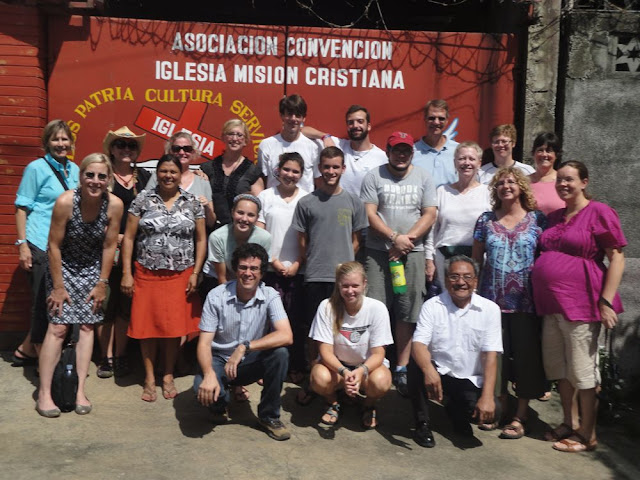
We received a very special delegation at the end of July/ beginning of August. Of course, all the groups that visit are special to us, but we really enjoyed helping to host a group that was moving from *knowing about* (saber) La Misión Cristiana and our work with them to really *getting to know* first-hand (conocer) the reality of Nicaragua and the church itself.

University Christian Church in Fort Worth, TX began to learn about the work that Global Ministries supports in Nicaragua because they met us when we spent a weekend with them in May 2010 as part of our preparation for going overseas. When we applied to serve with Global Ministries, they were in the middle of an interesting and challenging process, where they wanted to send new missionaries but needed extra funds to be able to support them. So they were seeking candidates and funds at the same time for ten positions the board had identified as the top priorities around the world. We were the first applicants who found a good fit with one of these positions -- and UCC in Fort Worth was the first church that identified some income from their endowed funds that could support Global Ministries sending a missionary somewhere in the world.

So, shortly after UCC called Global Ministries to share that they were ready to give the funds, we got a call to come in for the interview. And not too long after that, La Misión got the call saying that, if they were willing, they would be receiving us as missionaries. La Misión voted to receive us at their annual General Assembly in March.

When we spent the training weekend in May with UCC, we found out about yet another connection. In 2006, a Disciples minister from Texas had visited Nicaragua, and seen the infamous dump, La Chureca, where families lived in the mounds of trash, eking an existence out of looking for food and things that could be sold. It was a dangerous, unsanitary place for kids and adults alike. She was really depressed about the situation. When she got back to the US, she found out about a project called "Out of the Dump/ Project Chacocente" that was helping move families to a place where they could start new lives, farming small plots of land and living in a community. The project has also opened a school and a lending library in that community, further enriching the lives of the community members.

Rev. Laurie told this story at a youth conference in Texas as an example of how God is working even in situations that seem hopeless. Katie, a young woman who is a member of UCC (and now a college student) was inspired to organize a trip to Nicaragua to work with Chacocente. So she, with the support of Cyndy Twedell (the pastor at UCC who works most with mission, and spent a lot of time with us during our visit there last year) and Pastor Laurie, planned a mission trip that took place just a a few weeks ago. They spent the first part of the week building a classroom at Project Chacocente. They wrapped up their time there by taking some of the families to the beach.

They spent about 3 days with us and La Misión, staying at Centro Emmanuel, the church's training/ hospitality/ conference center in Ticuantepe, a small town just south of Managua.
They met with Rev. Rolando Boniche, the president of the church, and learned from him about some of the history of the church and its current work.
They helped with building a new house for the caretaker at Centro Emmanuel, a somewhat overdue project. (The church administrator said it was only by the grace of God that the old house had stayed standing long enough to be torn down.)


The group also got to experience a bit of Nicaraguan countryside and culture, visiting the Volcan Masaya:

the Catarina mirador:

as well as the traditional craft market in Masaya.

The Sunday night of their visit, they worshipped at the First Christian Mission Church in the Acahualinca neighborhood (not far from La Chureca, one of the many poor neighborhoods in Managua where La Misión churches are found). That was a powerful experience of welcome and unity across cultures for both the congregation and the visiting group. The electricity went on and off throughout the service, but the energy stayed high throughout. (It was also my first time translating a sermon from Spanish into English!)

We enjoyed the opportunity to get to know some of the UCC congregation better -- they were a great group, very flexible, hard-working, and open to new experiences and perspectives -- and they had a lot of fun together. Most of all, it was exciting for us to facilitate their introduction to Nicaragua and La Misión Cristiana.

Quinn loved "our friends from Texas," probably helped by the fact that they brought her presents -- a sweet little stuffed horse and book about a cowgirl that became instant favorites, as well as lots of stickers. :)

It was nice for her to spend time with a large group of English speakers who were interested in talking to and playing with her.