- The long-running border dispute between Nicaragua and Costa Rica has taken a new turn as Costa Rica has begun building a controversial road along their side of the Río San Juan. Environmentalists on both sides of the border have cried foul, saying it will lead to enormous environmental damage. Read more from John Perry and Nicaragua Dispatch.
- An interesting story about the founding of a fund for financing community development in Nicaragua, which grew out of the work of a very cool group called CEPAD.
- Where's the Latin American Science Fiction? (OK, I'm a geek... but actually, I've been asking in all the bookstores down here and nobody can seem to locate any for me. Magic realism they've got cold, but not so much with the sci-fi.)
- Does the U.S. have a double standard for elections in Latin America? (Hint: yes.)
- Nicaragua's renewable energy revolution cometh. More here on an army unit assigned to stop illegal deforestation.
Tuesday, January 24, 2012
Random Reading
Just a few random articles people might enjoy...

Wednesday, January 18, 2012
The High Cost of Being Poor
My Dad always talks about a story he heard from a Catholic priest who told him that he knew his parish was poor when they passed the offering plate and someone put in a dime and took back a nickel in change. As a kid I kinda figured this was just one of those stories. I mean, a nickel? But down here, a common addition to the offering plate in church is 10 cordobas, or a little less than 50 cents. The Misión churches are run on a flood of such small offerings, each given freely and with great love by folks who don't have a lot to spare.

Apropos of my last post on mission and development work, I've been thinking about that priest's story. I guess it dates back to the Depression when the phrase brother can you spare a dime meant something real. But we hear the same phrase here on the streets -- Dame un peso, chele -- often from little kids begging for change. In this case, they are literally asking us for a nickel. We see kids working here all the time. Kids come by our house selling tortillas, sometimes accompanied by parents, sometimes not. Kids perform in the street, juggling balls wearing sad-clown make-up, washing windows, selling food or newspapers at the stoplights. And yeah, we see them working during school hours.
Kids working when they should be learning seems crazy to me. I've always been taught that the way out of poverty is education. And it's true, and education is very clearly one of the church's top priorities. But in another sense, education is something of a luxury when your family doesn't have enough to eat and even young children are needed to work. Public school is free here, but even so we hear about families who are too poor to buy paper and pencil, much less a uniform.
In a macroeconomics context, the poverty trap posits that very poor countries don't save money because their citizens are living hand-to-mouth, and are therefore collectively unable to invest in the sort of infrastructure (decent roads to transport goods, electricity, public education, etc.) that make economic growth possible. From experience, we can say that roads, electricity and schools are all challenges once you get outside the cities. (If you're interested, click here for a long discussion in the context of tropical Africa; it's technical but not that hard to follow.)
The idea of a poverty trap is not uncontroversial (see here for an alternate view), but I think it makes a certain intuitive sense. A lot of development programs are based around the idea that well-targeted aid can help people "get over the hump." Some programs provide food security or basic health care so that people are able to work, while others provide access to credit (micro-lending) so people can start small businesses. Still others work to improve education to open up horizons for the future.
Anyway, this is one of the ways I've been conceptualizing some of the projects that we've been helping out with. More centrally la Misión Cristiana also sees these projects as one of the many ways it strives to preach the gospel ... using words when necessary.
Anyway, this is one of the ways I've been conceptualizing some of the projects that we've been helping out with. More centrally la Misión Cristiana also sees these projects as one of the many ways it strives to preach the gospel ... using words when necessary.
Tuesday, January 17, 2012
Baby Tour, Part One
Maya was born on September 12th, and we planned our family leave so that we could spend just over a month introducing her to her various relatives in the United States. We also planned it so that we would be in the U.S. for both Halloween and Thanksgiving. That timing meant we were there for Tim's mom's birthday, as well as Tim's and Quinn's. It also gave us enough time to do the paperwork to get Maya's Nicaraguan and U.S. birth certificates and passports so we could travel with her.
(Quinn actually had four birthday parties this year! The first with her classmates before we left Nicaragua, the second a few days before her birthday when we were still in California, the third: cake, singing, and a couple presents on her actual birthday, and a final bash with family in the DC area the weekend after her birthday. Let's just hope she doesn't expect 5 parties next year!)
Our flights (Managua to Houston, Houston to LA) were blessedly uneventful. Maya, at 6 weeks, slept most of the time. Quinn was really good and patient most of the way and only got bored or frustrated a couple of times. Highlights of our time in California included:
A visit to Storyland

Trick or treating!

Quinn was a butterfly fairy, and this was her first year trick or treating. (Last year she was old enough, but we were in Nicaragua, where it's not a tradition.) She was very excited about the costume, going out with her friends, and of course, the candy.


Maya was a pumpkin.

We spent a lovely day at Yosemite for Tim's mother's birthday, but forgot the camera! We also took a day trip to Oakland to visit our old stomping grounds and some dear friends and family.
We took a day trip to the Monterey Bay Aquarium.


Maya met her great-grandma Evie.

Quinn had her Fresno birthday party.


The best part, of course, was getting to spend quality time with the Tim-connected side of our family.
Quinn even decorated her Nana and Papa's Christmas tree before we left!

Look for the highlights of our time in DC soon...
(Quinn actually had four birthday parties this year! The first with her classmates before we left Nicaragua, the second a few days before her birthday when we were still in California, the third: cake, singing, and a couple presents on her actual birthday, and a final bash with family in the DC area the weekend after her birthday. Let's just hope she doesn't expect 5 parties next year!)
Our flights (Managua to Houston, Houston to LA) were blessedly uneventful. Maya, at 6 weeks, slept most of the time. Quinn was really good and patient most of the way and only got bored or frustrated a couple of times. Highlights of our time in California included:
A visit to Storyland
Trick or treating!
Quinn was a butterfly fairy, and this was her first year trick or treating. (Last year she was old enough, but we were in Nicaragua, where it's not a tradition.) She was very excited about the costume, going out with her friends, and of course, the candy.
Maya was a pumpkin.
We spent a lovely day at Yosemite for Tim's mother's birthday, but forgot the camera! We also took a day trip to Oakland to visit our old stomping grounds and some dear friends and family.
We took a day trip to the Monterey Bay Aquarium.
Maya met her great-grandma Evie.
Quinn had her Fresno birthday party.
The best part, of course, was getting to spend quality time with the Tim-connected side of our family.
Quinn even decorated her Nana and Papa's Christmas tree before we left!
Look for the highlights of our time in DC soon...
Friday, December 30, 2011
Texas delegation (July/August 2011)
When English speakers are learning Spanish, there are a lot of aspects of the language that can be confusing. One of these is the fact that Spanish uses two different words where English only uses "to know." We use the same word to say "I know how to do long division" or "I know that guy." Saber (know-how) refers more to knowledge of facts, whereas conocer has to do with familiarity.
We received a very special delegation at the end of July/ beginning of August. Of course, all the groups that visit are special to us, but we really enjoyed helping to host a group that was moving from *knowing about* (saber) La Misión Cristiana and our work with them to really *getting to know* first-hand (conocer) the reality of Nicaragua and the church itself.
University Christian Church in Fort Worth, TX began to learn about the work that Global Ministries supports in Nicaragua because they met us when we spent a weekend with them in May 2010 as part of our preparation for going overseas. When we applied to serve with Global Ministries, they were in the middle of an interesting and challenging process, where they wanted to send new missionaries but needed extra funds to be able to support them. So they were seeking candidates and funds at the same time for ten positions the board had identified as the top priorities around the world. We were the first applicants who found a good fit with one of these positions -- and UCC in Fort Worth was the first church that identified some income from their endowed funds that could support Global Ministries sending a missionary somewhere in the world.
So, shortly after UCC called Global Ministries to share that they were ready to give the funds, we got a call to come in for the interview. And not too long after that, La Misión got the call saying that, if they were willing, they would be receiving us as missionaries. La Misión voted to receive us at their annual General Assembly in March.
When we spent the training weekend in May with UCC, we found out about yet another connection. In 2006, a Disciples minister from Texas had visited Nicaragua, and seen the infamous dump, La Chureca, where families lived in the mounds of trash, eking an existence out of looking for food and things that could be sold. It was a dangerous, unsanitary place for kids and adults alike. She was really depressed about the situation. When she got back to the US, she found out about a project called "Out of the Dump/ Project Chacocente" that was helping move families to a place where they could start new lives, farming small plots of land and living in a community. The project has also opened a school and a lending library in that community, further enriching the lives of the community members.
Rev. Laurie told this story at a youth conference in Texas as an example of how God is working even in situations that seem hopeless. Katie, a young woman who is a member of UCC (and now a college student) was inspired to organize a trip to Nicaragua to work with Chacocente. So she, with the support of Cyndy Twedell (the pastor at UCC who works most with mission, and spent a lot of time with us during our visit there last year) and Pastor Laurie, planned a mission trip that took place just a a few weeks ago. They spent the first part of the week building a classroom at Project Chacocente. They wrapped up their time there by taking some of the families to the beach.
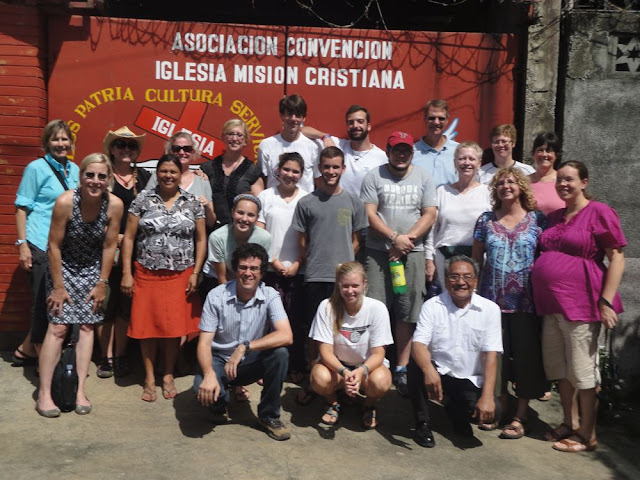
They spent about 3 days with us and La Misión, staying at Centro Emmanuel, the church's training/ hospitality/ conference center in Ticuantepe, a small town just south of Managua.
They met with Rev. Rolando Boniche, the president of the church, and learned from him about some of the history of the church and its current work.
They helped with building a new house for the caretaker at Centro Emmanuel, a somewhat overdue project. (The church administrator said it was only by the grace of God that the old house had stayed standing long enough to be torn down.)


The group also got to experience a bit of Nicaraguan countryside and culture, visiting the Volcan Masaya:

the Catarina mirador:

as well as the traditional craft market in Masaya.
The Sunday night of their visit, they worshipped at the First Christian Mission Church in the Acahualinca neighborhood (not far from La Chureca, one of the many poor neighborhoods in Managua where La Misión churches are found). That was a powerful experience of welcome and unity across cultures for both the congregation and the visiting group. The electricity went on and off throughout the service, but the energy stayed high throughout. (It was also my first time translating a sermon from Spanish into English!)
We enjoyed the opportunity to get to know some of the UCC congregation better -- they were a great group, very flexible, hard-working, and open to new experiences and perspectives -- and they had a lot of fun together. Most of all, it was exciting for us to facilitate their introduction to Nicaragua and La Misión Cristiana.
Quinn loved "our friends from Texas," probably helped by the fact that they brought her presents -- a sweet little stuffed horse and book about a cowgirl that became instant favorites, as well as lots of stickers. :)

It was nice for her to spend time with a large group of English speakers who were interested in talking to and playing with her.
We received a very special delegation at the end of July/ beginning of August. Of course, all the groups that visit are special to us, but we really enjoyed helping to host a group that was moving from *knowing about* (saber) La Misión Cristiana and our work with them to really *getting to know* first-hand (conocer) the reality of Nicaragua and the church itself.
University Christian Church in Fort Worth, TX began to learn about the work that Global Ministries supports in Nicaragua because they met us when we spent a weekend with them in May 2010 as part of our preparation for going overseas. When we applied to serve with Global Ministries, they were in the middle of an interesting and challenging process, where they wanted to send new missionaries but needed extra funds to be able to support them. So they were seeking candidates and funds at the same time for ten positions the board had identified as the top priorities around the world. We were the first applicants who found a good fit with one of these positions -- and UCC in Fort Worth was the first church that identified some income from their endowed funds that could support Global Ministries sending a missionary somewhere in the world.
So, shortly after UCC called Global Ministries to share that they were ready to give the funds, we got a call to come in for the interview. And not too long after that, La Misión got the call saying that, if they were willing, they would be receiving us as missionaries. La Misión voted to receive us at their annual General Assembly in March.
When we spent the training weekend in May with UCC, we found out about yet another connection. In 2006, a Disciples minister from Texas had visited Nicaragua, and seen the infamous dump, La Chureca, where families lived in the mounds of trash, eking an existence out of looking for food and things that could be sold. It was a dangerous, unsanitary place for kids and adults alike. She was really depressed about the situation. When she got back to the US, she found out about a project called "Out of the Dump/ Project Chacocente" that was helping move families to a place where they could start new lives, farming small plots of land and living in a community. The project has also opened a school and a lending library in that community, further enriching the lives of the community members.
Rev. Laurie told this story at a youth conference in Texas as an example of how God is working even in situations that seem hopeless. Katie, a young woman who is a member of UCC (and now a college student) was inspired to organize a trip to Nicaragua to work with Chacocente. So she, with the support of Cyndy Twedell (the pastor at UCC who works most with mission, and spent a lot of time with us during our visit there last year) and Pastor Laurie, planned a mission trip that took place just a a few weeks ago. They spent the first part of the week building a classroom at Project Chacocente. They wrapped up their time there by taking some of the families to the beach.
They spent about 3 days with us and La Misión, staying at Centro Emmanuel, the church's training/ hospitality/ conference center in Ticuantepe, a small town just south of Managua.
They met with Rev. Rolando Boniche, the president of the church, and learned from him about some of the history of the church and its current work.
They helped with building a new house for the caretaker at Centro Emmanuel, a somewhat overdue project. (The church administrator said it was only by the grace of God that the old house had stayed standing long enough to be torn down.)
The group also got to experience a bit of Nicaraguan countryside and culture, visiting the Volcan Masaya:
the Catarina mirador:
as well as the traditional craft market in Masaya.
The Sunday night of their visit, they worshipped at the First Christian Mission Church in the Acahualinca neighborhood (not far from La Chureca, one of the many poor neighborhoods in Managua where La Misión churches are found). That was a powerful experience of welcome and unity across cultures for both the congregation and the visiting group. The electricity went on and off throughout the service, but the energy stayed high throughout. (It was also my first time translating a sermon from Spanish into English!)
We enjoyed the opportunity to get to know some of the UCC congregation better -- they were a great group, very flexible, hard-working, and open to new experiences and perspectives -- and they had a lot of fun together. Most of all, it was exciting for us to facilitate their introduction to Nicaragua and La Misión Cristiana.
Quinn loved "our friends from Texas," probably helped by the fact that they brought her presents -- a sweet little stuffed horse and book about a cowgirl that became instant favorites, as well as lots of stickers. :)
It was nice for her to spend time with a large group of English speakers who were interested in talking to and playing with her.
Wednesday, December 28, 2011
So Who Won?
Following up on my earlier post, Nicaragua's national elections were held on November 6th. So who won?
The short answer is that Daniel Ortega and the FSLN won a resounding victory with 62% of the vote and 63 seats in the National Assembly. Opposition candidate Fabio Gadea and the Independent Liberal Party (PLI) won 31% of the vote and 27 seats. Former president Arnoldo Alemán wasn't really a factor, pulling only 6%.
The long answer very much depends on who you read or talk to. Gadea has refused to recognize the results, explicitly saying that he won the vote and that Ortega committed a massive fraud. Gadea's coalition mates, the breakaway Sandinista group MRS, have called Ortega a dictator and the opposition newspapers, such as La Prensa, have loudly denounced him. However, a planned protest march fizzled.
 The opposition points to a number of irregularities to make their case. In some cases observers from the opposition parties and third-party groups were refused access to the polling places. The election authorities have also not published precinct-by-precinct election results which would allow for a more comprehensive audit. There were also accusations that the government was selectively delaying requests for new ID cards, which are required to vote. (Update: More Ortega criticism here from Envio.)
Such irregularities, along with the experience of past elections, open the door to the idea that the incumbents were cooking the books. The PLI is claiming that 450,000 to 500,000 votes were stolen although they haven't offered much in the way of proof to back their claims. The good government group Ética y Transparencia published a statistical analysis claiming Ortega stole 150,000 votes -- a serious charge, but not one that would have reversed Ortega's 800,000 vote margin of victory.
In their defense, the Sandinistas point to a number of independent polls showing Ortega surging in the weeks before the election. A series of CID-Gallup polls showed steadily increasing support for Ortega and a final poll by Nicaragua's most respected pollster gave Ortega 58%. Sandinista supporters have also responded to the charges of irregularities in the election process.
I haven't dug deep enough to know how consequential these irregularities are, although my sense from the (unrepresentative sample of) people I've talked to is that, while there may have been some problems they didn't affect the outcome. Ortega won the election, and he won by implementing popular programs and riding the crest of a growing economy.
Which is not to say that the problems with the electoral process aren't real and troubling. Of the three official international observing teams (from the EU, the Organization of American States and the Latin American Council of Election Experts) both the EU and OAS reports detailed numerous structural and process problems with the elections. But the words of the head of the EU observation mission seem to sum up the uncertainty fairly well: "as to whether or not Daniel Ortega won, he won. Beyond that I won’t say."
[PS -- If you're looking for English language reporting on Nicaragua you should check out the new Nicaragua Dispatch (which leans anti-Ortega) or the Nicaragua Network (which leans left).]
The short answer is that Daniel Ortega and the FSLN won a resounding victory with 62% of the vote and 63 seats in the National Assembly. Opposition candidate Fabio Gadea and the Independent Liberal Party (PLI) won 31% of the vote and 27 seats. Former president Arnoldo Alemán wasn't really a factor, pulling only 6%.
The long answer very much depends on who you read or talk to. Gadea has refused to recognize the results, explicitly saying that he won the vote and that Ortega committed a massive fraud. Gadea's coalition mates, the breakaway Sandinista group MRS, have called Ortega a dictator and the opposition newspapers, such as La Prensa, have loudly denounced him. However, a planned protest march fizzled.
The opposition points to a number of irregularities to make their case. In some cases observers from the opposition parties and third-party groups were refused access to the polling places. The election authorities have also not published precinct-by-precinct election results which would allow for a more comprehensive audit. There were also accusations that the government was selectively delaying requests for new ID cards, which are required to vote. (Update: More Ortega criticism here from Envio.)Such irregularities, along with the experience of past elections, open the door to the idea that the incumbents were cooking the books. The PLI is claiming that 450,000 to 500,000 votes were stolen although they haven't offered much in the way of proof to back their claims. The good government group Ética y Transparencia published a statistical analysis claiming Ortega stole 150,000 votes -- a serious charge, but not one that would have reversed Ortega's 800,000 vote margin of victory.
In their defense, the Sandinistas point to a number of independent polls showing Ortega surging in the weeks before the election. A series of CID-Gallup polls showed steadily increasing support for Ortega and a final poll by Nicaragua's most respected pollster gave Ortega 58%. Sandinista supporters have also responded to the charges of irregularities in the election process.
I haven't dug deep enough to know how consequential these irregularities are, although my sense from the (unrepresentative sample of) people I've talked to is that, while there may have been some problems they didn't affect the outcome. Ortega won the election, and he won by implementing popular programs and riding the crest of a growing economy.
Which is not to say that the problems with the electoral process aren't real and troubling. Of the three official international observing teams (from the EU, the Organization of American States and the Latin American Council of Election Experts) both the EU and OAS reports detailed numerous structural and process problems with the elections. But the words of the head of the EU observation mission seem to sum up the uncertainty fairly well: "as to whether or not Daniel Ortega won, he won. Beyond that I won’t say."
[PS -- If you're looking for English language reporting on Nicaragua you should check out the new Nicaragua Dispatch (which leans anti-Ortega) or the Nicaragua Network (which leans left).]
Monday, December 19, 2011
Catchy Christmas Carol
We may have mentioned before that life in Nicaragua can be rather, well, loud. For example, the Catholic Church down the street practices a daily advent celebration that involves blasting Christmas carols over their loudspeakers. At 3 or 4 in the morning. For 30 to 40 minutes. Accompanied by fireworks. Every day until Christmas.
Now I am not at my best at 3 a.m. and, in the moment, I am not generally very appreciative of these full-volume, pre-dawn serenades. Un-charitable thoughts have been known to flit through my sleep-fogged brain. However, one of this morning's songs was so INSANELY catchy that I've been humming it constantly ever since. Maybe the fact of hearing it while half-asleep helps to burn it deeper into your synapses? Laura Jean helped me track it down this morning -- apparently it's a very popular children's carol about traveling to Bethlehem to see the baby Jesus:
Now I am not at my best at 3 a.m. and, in the moment, I am not generally very appreciative of these full-volume, pre-dawn serenades. Un-charitable thoughts have been known to flit through my sleep-fogged brain. However, one of this morning's songs was so INSANELY catchy that I've been humming it constantly ever since. Maybe the fact of hearing it while half-asleep helps to burn it deeper into your synapses? Laura Jean helped me track it down this morning -- apparently it's a very popular children's carol about traveling to Bethlehem to see the baby Jesus:
Thursday, December 15, 2011
Mission Moment
This Sunday the Global Ministries weekly prayer comes to Nicaragua and la Misión Cristiana. You can read the mission moment on the website and below:
Pray for Nicaragua on Sunday, December 18, 2011
Prayers for Nicaragua: Luke 1:26–38
Our God of unexpected blessings and perplexing good news, we thank you for your servant Mary. We thank you for her “yes” to your invitation to give birth to Jesus our Savior. We pray that you would give us the courage to respond with a “yes” when you send us unexpected messengers and perplexing tasks.
We praise you for your wondrous ways, for calling a young woman from Nazareth to be the mother of Your Son. We praise you for calling forth leaders for your church from all parts of the world and all walks of life. We pray for the leaders you have called and are calling to lead the Christian Mission Church of Nicaragua.
You have called women and men, from the country and the cities, young and old. All hunger to know more about you and your Word. We pray for the church’s program of ministerial formation. Guide the Department of Theology and the facilitators as they plan, travel, and teach. Give the students patience, perseverance, and resources to continue. Equip and empower these servants of yours to be a light to Nicaragua, and to the world. Ever remind us that with you, nothing is impossible. Amen.
Mission Stewardship Moment from Nicaragua:
 Nicaragua is a country where formal educational opportunities rarely keep pace with people’s thirst for knowledge. Knowing this, La Misión Cristiana has long worked to provide first-rate theological training to their pastors and lay leadership. So it was an exciting moment when in August of this year the church kicked off a two-year project in theological education.
The project began with nine churches in the capital of Managua. Very quickly, the offering of a weekly two-hour theology class attracted more interested people than could be accommodated! Relying on the expertise of several members who are current or former theology students at the Evangelical University of Nicaragua, the project organized five weekly classes, each one serving a pair of churches. Before our daughter Maya was born, Laura Jean was teaching two of the five groups (with Tim’s assistance). The first few topics included a history of Pentecostalism, the World of the Old Testament, and a seminar on the Church Confronting the Problem of Violence.
The project is now expanding into the other regions of Nicaragua. In the rural regions, where churches are far-flung and transportation is difficult, the project has planned a series of meetings where the students and teachers gather together for 4-5 days of intensive study. Last weekend, Laura Jean co-taught a four-day course for students from the seven churches in the Western region and the project will soon extend to the South, East and North as well. Support from Global Ministries is critical in buying materials and paying for the transportation that bring people together to do this good work.
Pray for Nicaragua on Sunday, December 18, 2011
Prayers for Nicaragua: Luke 1:26–38
Our God of unexpected blessings and perplexing good news, we thank you for your servant Mary. We thank you for her “yes” to your invitation to give birth to Jesus our Savior. We pray that you would give us the courage to respond with a “yes” when you send us unexpected messengers and perplexing tasks.
We praise you for your wondrous ways, for calling a young woman from Nazareth to be the mother of Your Son. We praise you for calling forth leaders for your church from all parts of the world and all walks of life. We pray for the leaders you have called and are calling to lead the Christian Mission Church of Nicaragua.
You have called women and men, from the country and the cities, young and old. All hunger to know more about you and your Word. We pray for the church’s program of ministerial formation. Guide the Department of Theology and the facilitators as they plan, travel, and teach. Give the students patience, perseverance, and resources to continue. Equip and empower these servants of yours to be a light to Nicaragua, and to the world. Ever remind us that with you, nothing is impossible. Amen.
Mission Stewardship Moment from Nicaragua:
Nicaragua is a country where formal educational opportunities rarely keep pace with people’s thirst for knowledge. Knowing this, La Misión Cristiana has long worked to provide first-rate theological training to their pastors and lay leadership. So it was an exciting moment when in August of this year the church kicked off a two-year project in theological education.The project began with nine churches in the capital of Managua. Very quickly, the offering of a weekly two-hour theology class attracted more interested people than could be accommodated! Relying on the expertise of several members who are current or former theology students at the Evangelical University of Nicaragua, the project organized five weekly classes, each one serving a pair of churches. Before our daughter Maya was born, Laura Jean was teaching two of the five groups (with Tim’s assistance). The first few topics included a history of Pentecostalism, the World of the Old Testament, and a seminar on the Church Confronting the Problem of Violence.
The project is now expanding into the other regions of Nicaragua. In the rural regions, where churches are far-flung and transportation is difficult, the project has planned a series of meetings where the students and teachers gather together for 4-5 days of intensive study. Last weekend, Laura Jean co-taught a four-day course for students from the seven churches in the Western region and the project will soon extend to the South, East and North as well. Support from Global Ministries is critical in buying materials and paying for the transportation that bring people together to do this good work.
Subscribe to:
Posts (Atom)