Tuesday, September 4, 2012

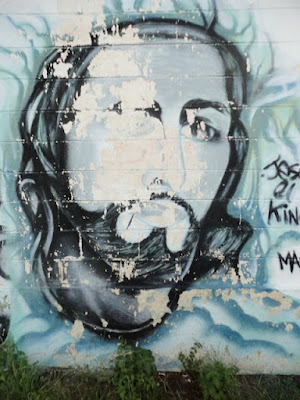
Mural Muro

Here are a few faces peering out from the walls in our neighborhood.

Monday, September 3, 2012

Evangelical Musical Sampler, Vol. 3

It's been awhile since I've posted about the music we hear in church. So here are a few more pentecostal tunes to start your week.

Our first song is one of the biggest crowd-pleasers in the repertoire -- "Alaba a Dios" ("Praise God") by Danny Berrios. It's got a great build to a dramatic chorus and it does that ascending key change thing at the end. The church often busts it out when they want to bring their "A" game. Church services typically open with an hour of music and this is often the capstone just before the preacher starts.

There are really only a handful of songs that were familiar to us from the U.S. When we have groups visiting, "We Are Walking in the Light of God" is popular since the Spanish version, "Caminando en la Luz de Dios" is well-known. (I keep pushing to get people to sing the Siyahamba verses too.) Occasionally we hear songs that meld church-y lyrics to popular tunes like "The Battle Hymn of the Republic" or this one (listen and let me know if you recognize the melody).

But one popular song that does earn that shock of recognition for us is "Abre Mis Ojos, o Cristo", a translation of "Open the Eyes of My Heart." Thankfully, the Spanish avoids the mixed metaphor of the English version. I could never help picturing a Valentine heart with animated eyeballs when singing this song.

The next song -- "Este corito es" ("This Choir is...") by Doris Machin -- is super-pentecostal in its theme (lots of Holy Spirit) and is one of Laura Jean's favorites because it has fun participatory dance moves. Now everyone spin around!

One more for a closer: here's "Te doy gloria" ("I give you glory") by Luz y Salvación. Mosh pit!

Wednesday, August 29, 2012

Teaching

People often ask what a typical week looks like for us, and the answer, truthfully, is that there are no typical weeks. Our schedule sloshes around depending on the events of the week, although one constant for both of us has been teaching.

Both Laura Jean and I spend a fair amount of time teaching classes, both at CIEETS and in the churches -- which is to say working with both formal and popular educational models. Laura Jean has already posted about the theological education project, and I've been helping organize a writing and research workshop at CIEETS for students writing their senior thesis, as well as a series of talks in the Mission Churches on environmental science, ecology, climate change and the like.

Laura Jean with some of her students from the Northern region.

Playing the ecosystem game.

We teach in Spanish, which is difficult and a lot more work, but has also really helped us improve our grasp on the language.  It helps that our students are extremely patient with us and tolerant of our mistakes. You can usually tell by the puzzled looks when a phrase or explanation doesn't connect. It makes me empathize with (and respect) all those Russian and Chinese physics TA's I had in college! Teaching in Spanish has probably also made me a more organized and deliberate teacher, knowing that I can't just "wing it" with minimal preparation.

Last year, we also helped out by teaching English to the kids at the Marcelino Davila School at the Second Church of the Christian Mission. The school is an official K-6 private primary school serving the José Dolores Estrada neighborhood. We were asked by Doña Pilar, who is the pastor of the 2nd church to help out the directora of the school with English classes.

Now there are many people in this world for whom teaching children is their life work. They have studied and practiced their art and are extremely good at their jobs. Those people are Awesome. But I am not one of them. When I was in the moment actually teaching the class, I enjoyed the experience. But leading up to each class, I was a bundle of nerves. Put me in front of a room full of adults (or even high-schoolers) and I’ll happily blather on about most things, but 4th graders? Terrifying.

So teaching kids is not my gift in life, but once I got over my nerves, I do think that the teaching itself went pretty well. Plus it was wonderful to be part of the school community. This year I've been busy with other projects, and I find myself missing the students and the teachers, the sheer energy and noise of the playground, the group hugs from the littler kids (who shout “Teacher de Inglés!” when they see me, which either means I’m doing an excellent job or a terrible one).

Kids from the Marcelino Dávila school

It’s a pretty common experience for overseas volunteers to be asked to teach English, because it’s (1) a desired skill, and (2) one that you are actually qualified to do. Actually scratch #2, being able to speak English is entirely different than teaching it. The crazyness of one's native tongue is mostly invisible until forced to explain it in front of a group.

Last year I had a sudden revelation about how English (unlike Spanish) uses "do/does" as a helping verb to form questions or to emphasize responses ("Do you know what I mean?").  Unfortunately I had this revelation while standing in front of the white board, marker in hand, trying to answer a question. I literally had not thought about it before that moment. Goes to show that you usually learn more about a subject by teaching it than through any other method.

Wednesday, August 15, 2012

Ministerial Formation Turns One

Our daughter Maya turned 11 months old on Sunday, and I find it hard to believe that we're less than a month away from her first birthday!  We're getting close to our two-year anniversary of arriving in Nicaragua, and the second year has seemed to go by even faster than the first did.

I've also been congratulating students, facilitators, and organizers recently on another important anniversary.  On August 8th, 2011, one month before Maya's due date, we began teaching in the Ministerial Formation program.  This program is the reason La Misión Cristiana asked Global Ministries to send a missionary to Nicaragua to work with them.  The need for this program was the heart of the job description that was such a good fit for my gifts and interests that I began to sense God calling me to Nicaragua once I heard about it, and it is also the heart of what I spend my time, energy and effort on here.  (Not all jobs actually turn out that way... especially in the mission field.  I consider myself quite fortunate in that respect. :) )

I often say, half-jokingly, that the Ministerial Formation program is my "other baby."  So, perhaps you would like to know what Ministerial Formation is (i.e. what it is I'm doing here, anyway).

The need that the Junta Directiva (National Board) of La Misión Cristiana identified was theological training for its pastors and leaders, training that would be steeped in the particular identity of this Nicaraguan, Pentecostal denomination committed to social justice and service to the "least of these."  (See what I mean about the job description?  Theological education and social justice?  Be still my heart!)

The educational backgrounds of  La Misión pastors vary widely.  Some have college degrees in theology; others did not complete primary school.  Many pastors have years, even decades, of pastoral experience but no formal theological training.  Life in el campo (the countryside) is very different than life in Managua, the capital, and the more remote the location, the fewer opportunities there are for education.  The other reality is that lay people do a lot of teaching and preaching, and so also need formation in the beliefs and identity of the church.

Taking this context into account, the national Theology Department and the National Board approved a proposal prepared by Carlos Sediles (a Nicaraguan church member working on a doctorate in theology, like me, his official role is an advisor for the project), for a program of Ministerial Formation.  This program aims to:

1) be grounded in the identity of La Iglesia Misión Cristiana.
2) use popular education as its methodology, so it can:
    a. value the life experience students bring to their studies, and
    b. be accessible to students with a variety of formal educational backgrounds.
3) provide practical tools for ministry.
4) provide a solid foundation for further study of the Bible.
5) be comprehensive, giving at least a basic introduction to all the necessary areas.
6) be officially recognized; students who complete all the coursework will receive a diploma from the church, and we hope to have it recognized by CIEETS (the Protestant theological faculty where we also teach) as well.

We've designed it as a two-year program of study, and it has a different schedule in each of the 5 regions of the country.  We started weekly classes last August in the central region (Managua area), so the students in those groups are now halfway through.

We leave tomorrow in the early morning to give a 4-day intensive course in the Western region, at the end of which those students will also be halfway done.  By the end of 2012, they will have covered 3/4 of the curriculum.  The Northern region will be halfway done by the end of 2012.  The Southern and Eastern regions (both very small) will probably begin in 2013.

So, Happy Birthday to my "other baby"!  I'm amazed by the work that our team of organizers and facilitators has done, and the commitment of the students who dedicate this time to their formation so they can become better leaders of their church.

Friday, August 10, 2012

It Works!

When last we left the biodigester, it had been successfully installed but was not yet functional. The biodigester's big plastic bag needs to be first filled with 50 buckets of (ahem) cow poop and 50 buckets of water (perhaps with a dash of molasses). And then we wait for the bacteria to do their work. The bag begins to inflate with methane gas and after a few weeks it is ready for use.

Pastor Eustachio had told me when I saw him in March that the biodigester was working really well, but we had not been able to return to see for ourselves.  Thankfully a visiting group from Ohio was really excited to make the 3 hour trip to San Pedro to learn about and see the biodigester project. [*]
So, as you can see, it works!  This is the fully inflated biodigester, with the beginnings of a brick protective wall around it.
Pastor Eustachio explains to Hno. Boniche (the presidente of La Misión) and members of the Ohio group how the biodigester works.
And here's the result: a successful blue flame coming out of the stove-top!
A daily bucket of manure and another of water provides about 4 hours of gas for cooking. The one drawback is that the big pots used for soup or other large dishes don't fit on the small range, and so the family still uses the wood stove for some meals. So the biogas is not replacing 100% of the family's wood use, but it's a start!

This month we are laying plans to build the second biodigester (rainy season permitting) in the nearby village of Malpaso. The generous help of several of the groups who have visited La Misión Cristiana this summer--including the brothers and sisters from Ohio who trekked all the way to San Pedro--has been key to moving ahead on this project.

[*] Actually we just said goodbye to the eighth group (out of nine) who has come to visit and spend time with La Misión Cristiana this year. This may help explain why blogging has been light non-existent over the last few months.

Friday, June 29, 2012

Mission Moment

Nicaragua is up to bat again for Global Ministries' weekly prayer -- you can read it here or below.

June 22, 2012


Prayers for Nicaragua: Mark 5:21-43

Most Holy God, we thank you for your healing touch in so many lives, for those you raise up, and those who reach out to touch you.  There are so many in this world, both near and far, who need to be made whole.  There are places where it is hard to see life, people who have been suffering too long.  

Most Beloved God, we lift up to you the people of the Christian Mission Church of Nicaragua, we thank you for their faithful service to you, their work serving the least and reaching the lost.  We thank you for the ways that your liberating Spirit moves through them to empower so many to reach out for their healing, to rise up and live abundantly.

We pray for the church as they receive visiting Disciples and UCC groups this summer.  We ask the eyes and ears of delegations be opened, that they might learn and grow, and know the healing and empowering touch of your Spirit.  Help them, and us, to work to restore wholeness.  In Jesus’ name we pray.

Amen.  

Mission Stewardship Moment from Nicaragua:

This year La Misión Cristiana is blessed to host more than eight groups from Disciples and UCC churches. Building relationships with other churches has been a part of La Misión’s DNA since its founding and they are excited to show Nicaraguan hospitality to so many North American sisters and brothers this year. For us, some of the best moments of these visits come in the gaps between the events on the official schedule. Jokes, laughter, stories about family, questions about food or songs, the accumulation of small bits of shared time, over the course of a week sometimes grows into friendship.

Shared worship services are also powerful moments. In one worship service last year, a rousing praise song was given an unexpected jolt by the sudden disappearance of light and the electric sound system. (Power outages are not uncommon here.) But like an a capella closing to a rock song, the congregation didn’t miss a beat and kept singing in the dark amidst a forest of cell phones and quickly-lit candles.

More recently, the pastor of one of the visiting groups was asked to preach at a local church, with Laura Jean translating the sermon into Spanish. Now you might think that such a set-up is a recipe for miscommunication or puzzlement, but the sermon touched a universal nerve, preaching how God calls us to do the uncomfortable and the difficult even when we think we are not up to the task. God asks us to go out into the “deep water.” As it happened, the denominational president, Rolando Boniche, was in attendance for that service and he later told the group that the message of the sermon reached him just at the moment when he needed the uplift.

There are so many ways we might fail to connect with our fellow humans. Language barriers confound us, national borders separate us, and the hassles of everyday life distract us. Speaking as parents of small children, we know how easy it can be to not to look beyond the crisis of the moment. It is good to remember in the midst of all that, that connection is indeed possible and there are churches everywhere willing to head out into that deep water and find what God has in store for us there.

Friday, June 1, 2012

Good Intentions

As I was writing that last blog post about life in the countryside, I kept turning over in my head a blog post written by a friend of ours titled "To Hell With Good Intentions." It's smart, eloquent and challenging.  I'll just quote part of it, but the whole thing is good.
For all of us who go to Nicaragua – or indeed, any place poorer than where we are from: India, Mexico, Appalachia, Detroit – our first instinct is to fix it. Whether we will admit it or not, the very first thing we do when confronted with a terrible situation is to furiously work through possible responses to that problem in our mind until we hit upon the “magic” solution.

I know this because I do it all the time. Even after ten years of living in Nicaragua, I still do it. I go to Nueva Vida, the neighborhood created by Hurricane Mitch resettlement, and with everything I see, I work through scenarios to “fix” what is “wrong” in Nicaragua.
I do it too.  I think this instinct is a mixture of good intentions and a subconscious desire to recreate something safe and well-understood amidst the chaos of a different culture.  But I have noticed, after having lived here almost 2 years, that most of my first impressions were untrustworthy.

For me the process cultural acclimatization started out like this: first I encounter something new and unusual.  Cold showers? What's up with all the trash in the streets?  Even more mundane things like, why do they only sell cookies in "wasteful" individual-sized packaging?  My first reaction is to see these things as an irritation (and maybe not even consciously). Or maybe the result of Nicaragua's poverty, and hence, a problem to be fixed.

In fact, it's remarkably easy to pin these differences on poverty because, well, Nicaragua is a poor country and the very real problems of poverty are visible.  But with time you start to realize that many of those "problems" are subtly mixed together with differences in culture and it can be difficult to tease them apart. There are actually really obvious reasons for many of those initial differences I saw.  For example, they individually wrap the cookies because food goes stale much, much faster here than in more temperate climes -- it would actually be much more wasteful to do it the way I wanted to!

I don't mean to minimize the problems that Nicaragua faces, just to say that poor campesinos don't necessarily look at their packed dirt floor and plastic chairs and see a problem to solved.  It's just part of the culture.  I've heard many folks tell us how they prefer the country lifestyle to the more "affluent, western" version they could find in Managua.  Poverty doesn't encompass who they are.  Another section of the post also stuck with me:
When I first came to Nicaragua, I thought I was coming to help Nicaraguans. I was sorely mistaken. None of us are needed here. No matter what my skills are, Nicaraguans are capable of doing everything I will do here, and in most cases, do it better, faster and more efficiently. So what is it exactly that I do?
It's an unsettling perspective, but it kinda fits with our experience here.  In fact, when we first got here we were a bit of a liability.  We spoke Spanish poorly, we didn't know the culture, customs, history or our way around the city.  The folks from the church basically took us in like we were war orphans.

OK, maybe not thaaat bad, but I think it is only now, after a year and half in Nicaragua, that we are starting to pull our weight.  We both bring skills to our work, but they are not unknown skills.  We might not be needed, but I know that the church is happy to have us and the many visiting congregations as partners in their work.  It's a reminder that when we work together in partnerships we can accomplish more.